Loredana Veniamin, teacher
From their
earliest years, children are surrounded by texts that combine images and words,
on screen and on paper, in the home, in the street and in school. This means
that they bring a wide experience of texts to their school work, expecting to
read images as well as print and, increasingly, expecting to use computers in
seeking information. When they come to express ideas in classroom work, children
readily draw on their experience to create multimodal texts using words,
diagrams and pictures. And, for the majority of teachers, the children’s
existing knowledge of picture books should be the starting point for
discussion.
The new
forms of communication, and the knowledge of texts brought to the classroom by
even the very youngest readers and writers, pose new questions for teaching and
learning. Many books and other media now available in schools cannot be read by
attention to writing alone.We read them differently
from the way we read continuous print, making different choices about where to
start reading: often the eye falls on a strong central image, or a colored text
box presented as a ‘fascinating fact’; or the arrows on a diagram might direct
our gaze. With continuous print we also make choices about how we take in the
meaning, but usually, in order to make sense of it, at least on first reading,
we tend to read according to the direction of print. The students are aware of
these differences, and the layout options available, and their reading
knowledge influences how they use pictures and words to communicate their own
ideas. When children use multimodal ways of presenting ideas (often pictures
plus words) they use their knowledge of spatial organization as well as print conventions.The more channels students have to select from when composing
and exchanging meaning, the more resources they have at their disposal for
being successful communicators. Aural and video compositions sometimes reveal
and articulate meanings students struggle to articulate with words; audio and
visual compositions carry different kinds of meanings that words are not good
at capturing. It is the thinking, decision making, and creative problem solving
involved in creating meaning through any modality that provide the long-lasting
and useful lessons students can carry into multiple communicative situations.
The
classroom accounts and activities show how using visual approaches – and
audio-visual– can build on children’s knowledge of a range of multimodal texts.
There are examples of teaching sequences using film, real-life observations,
presentation software and the interactive whiteboard. Gieck
and Brabec (2002) acknowledge that using technology for such things as
composing, revising and sharing has varying benefits. Teachers who are willing
to explore can find out for themselves how much their students will benefit
from writing with technology in their classrooms.
Pre-writing activities
Pre-writing
strategies help students to generate or collect ideas, recording these thoughts
on paper. Writers’ block can result from not providing students opportunities
to do this. Once students have initial ideas with which to work, they can then
build upon them by organizing their ideas for writing—considering sequence,
creating an outline, focusing on an audience and purpose, etc.
A good way
to begin is by stimulating ideas and allowing the students to talk about topics
that they find interesting and motivating. They should also be guided to select
Internet sites to find writing prompts or discussion starters. Talking before
writing serves as a catalyst for more ideas.
Activity
1. Wiki-based collaboration and brainstorming
Level:
upper-intermediate to advanced
Time: 50
minutes
Aims: to
help with the task of generating ideas before writing
Procedure: The
teacher introduces o topic that the students might find interesting and
motivating and writes the headline on the blackboard. Then he or she will put
the students in pairs and ask them to access the web server, previously
installed on their computers.
A wiki can allow many developing ideas to be
captured quickly and promotes the organic structuring and growth of these ideas
as they develop. The pooling nature of the wiki supports mutual stimulation and
as the site develops it becomes easier for participants to ‘spark off’ from and
elaborate on existing ideas. Crucially, not only is this supporting ad hoc
collaboration and data in the early stages but as the page develops and the
information crystallizes, it should be seen to capture more structured data as
it progresses.
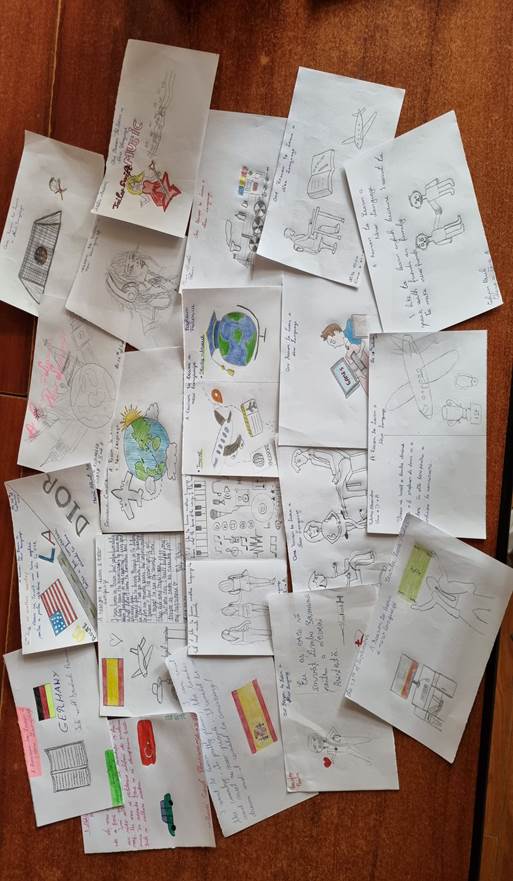
While-writing
activities
While-writing
activities range from drafting and redrafting to conferencing and
collaborating, to revising, editing, and evaluating.
Level:
intermediate to advanced
Time: 50
minutes
Aims:
-
to allow the learners to explore the
relationship between purpose,audience, and appropriate
language use;
- to guide the students through
the process of writing original e-mail messages or letters demonstrating the
effect of purpose and audience on language use and word choice.
Procedure: The teacher distributes
the Internet Abbreviations and
Shortcuts handout to each student, or shows the chart on an
overhead projector. He allows students time to expand each abbreviation.
As the teacher discusses
the abbreviations and their meaning, the class can add to the list. The
students are allowed to share only abbreviations that are appropriate for the
classroom community.
Expanded Internet
Abbreviations and Shortcuts
|
TOY
|
thinking of you
|
|
FYI
|
for your information
|
|
B4
|
before
|
|
KIT
|
keep in touch
|
|
TNX
|
thanks
|
|
GBH
|
great big hug
|
|
BCNU
|
be
see in’ you
|
|
PLS
|
Please
|
|
R&R
|
rest and relaxation
|
|
4ever
|
forever
|
|
ASAP
|
as soon as possible
|
|
OIC
|
oh
I see
|
|
ILY
|
I love you
|
|
BC
|
because
|
|
LOL
|
laughing out loud
|
|
CU
|
see you
|
|
SFSG
|
so far so good
|
|
NOYB
|
none of your business
|
|
ABT
|
about
|
|
JK
|
just kidding
|
|
IOW
|
in other words
|
|
KWIM
|
know what I mean
|
|
BTW
|
by the way
|
|
POV
|
point of view
|
|
NE1
|
anyone
|
Dr. Principal Smith,
How r u? Just shooting you an em to ask u 4 the newtxtbks. The
class is going SFSG.BTW, the students have been asking abt
the field trip. Could you plsem me backb42longto work
out the details?Thnx.TTYL.
Mrs.Jones
Post-writing
activities
We define post-writing as the step in the writing process where the
written text is shared with other audiences, such as a peer-editor or the
instructor or even with the general public. The post-writing activities should
involve the students in:
·
Re-reading their story, make sure the sentences make
sense.
·
Adding phrases to make the story flow smoothly
(cohesion markers, pronouns, conjunctions).
·
Eliminating "fluff" (unnecessary or
redundant details).
·
Proofreading for spelling, vocabulary, grammar
(checklist).
·
Editing their paper (peer-editing, post-teacher
editing).
·
Sharing with audience (website, print, etc.).
Post-writing
activities help students polish their work. Teaching the students to complete
post-writing activities with each assignment will help them to grow as writers
and gain confidence in their writing skills.
Level: beginners to advanced
Time: 50 minutes
Aims:
- to have the students analyze their own
images by determining which pictures best represent the abstract concept and
writing about their choices;
- to have the students analyze the
work of their peers by posting responses to a blog that make connections
between the photos.
Procedure: the
teacher has the students spend five minutes brainstorming and writing about
what images come to mind when they think of the word ‘success’.
The students move to the computers and search on the Internet for pictures which best
illustrate this concept, in their opinions. They are instructed to consider what success looks like in each image and why they think the
picture should be chosen. They upload
their pictures on the classroom blog, adding a rationale for their choices.
The next step involves
the students reviewing each other's pictures and descriptions. They should post
responses to a number of pictures that the teacher specifies (which will vary
according to the size of the class and the amount of time available).
Before the students
post, the teacher should discuss what the responses should contain. Each post
should contain a statement of agreement/disagreement with the picture
description and a rationale for the statement. The response should also refer
to other students' pictures. Ideally posts will reflect on commonalities and
differences between the pictures and will also deepen discussion of the
concepts being explored.
Picture Selection
Sheet
Name: Date:
Instructions: Assign
each picture you have taken a number and write it on the back. Fill in the
boxes about it in the appropriate spaces on the grid. When you are finished, circle
the 3 photos that have the lowestratings in the last column.
|
Picture Number
|
What
does this picture say about courage? How is courage demonstrated?
|
What character
from our readings would agree with this?
|
How easy would it be to write about courage using this
picture? Rate your response from 1 to 5 with 1 being easy and 5 being hard.
|
|
|
|
|
|
|
|
|
|
|
Picture
and Blog Entry Rubric
Teacher Name:
Student Name:
|
CATEGORY
|
4
|
3
|
2
|
1
|
|
|
Meaning behind
The picture
(Original post)
|
Postings
are able to go “behind” the
pictures
and explain the contexts.
|
Postings
are beginning to be able to go “behind” the pictures and include
some explanation of the context of the pictures.
|
Postings
don’t go “behind” the pictures, but include some explanation of the context
of the pictures.
|
Postings
do not go
“behind” the pictures and there is little to no explanation
of the context of the pictures.
|
|
|
Connection
to texts read (Original post)
|
Postings demonstrate a
strong sense of
understanding
of the books and characters referenced.
|
Postings demonstrate sense
of understanding
of the books
and characters referenced.
|
Postings
demonstrate a
beginning
sense
of
understanding
of the
books and characters referenced.
|
Postings demonstrate
little or no sense of understanding
of the books and characters
referenced.
|
|
|
Makes sense
of
courage (Original
post)
|
Postings show a
strong idea of what
success is and use
many examples to explain
thinking.
|
Postings
show
an idea
of what
success
is and use
some
examples to explain thinking.
|
Postings
show a
beginning
idea of
what success
is and
use
few examples to explain thinking.
|
Postings show little to no idea
of what success is and use no examples to explain thinking.
|
|
|
Pictures
(Original
post)
|
Success is clearly
represented in the
pictures—it is clear
why the student
chose them.
|
Success can be
figured out from
the pictures, but
some description is necessary to
clarify.
|
Success
is not
well represented
in the
pictures
and a description
is necessary
to
understand
what
the pictures
say
about Success.
|
Success is not
represented and the descriptions
do not help
in developing the idea of Success.
|
|
|
|
|
|
|
|
|
|
|
|
|
|
Makes sense
of
courage
(Response
posts)
|
Responses show a
strong idea of what
Success is and use
many examples to explain
thinking.
|
Responses show
an idea of what
Success is and use
some examples to explain
thinking.
|
Responses
show a
beginning
idea of
what Success
is and use few examples to explain thinking.
|
Responses show little to no idea
of what Success
is and use no examples to
explain thinking.
|
|
|
Connection
of
themes
(Response
posts)
|
Student is able
to connect five
or more pictures
together and find
common elements.
|
Student is able
to connect four
pictures together
and find common
elements.
|
Student
is able
to connect
three
pictures
together
and find
common
elements.
|
Student is able to connect two
pictures together and find common elements.
|
|
|
Connection
of texts
read
(Response
posts)
|
Responses demonstrate a strong
understanding of the books and
characters referenced.
|
Responses
demonstrate
understanding
of the books and characters referenced.
|
Responses
demonstrate
an elementary
understanding
of the books and characters referenced.
|
Responses demonstrate little or
no understanding of the books and
characters referenced.
|
|
|
|
|
|
|
|
|
|
|
https://www.gettyimages.com/photos/courage
Gabriela-Brândușa Horlescu,
teacher
Evaluation
Test No. 1
1.Which of the following peripheral device is NOT an
input device:
a) Keyboard
b) Monitoring
c) Scanner
d) Mouse
2. What type of computer is used as an electronic diary,
calendar, pocket calculator?
a) laptop
b) the tower
c) Palm PC
d) Supercomputer
3. Input device that reads printed information from paper
and converts it into digital format:
a) Bright pencil
b) Monitor
c) Scanner
d) Touch screen
4. Hard disk capacity is usually
measured in:
a) bytes
b) KB
c) MB
d) GB
5.You want to add RAM to a computer. What size would you
choose?
a) 256 MB
b) 256 TB
c) 256 b
d) 12 b
6. Hardware represents:
a) the physical and technical equipment necessary for data processing
b) the logical equipment necessary for data processing
c) all programs, applications used for data processing
d) the arithmetic and logical devices necessary for data processing
7. Example of core software:
a) word processor
b) spreadsheet application
c) operating system
d) electronic presentations
8. A computer connected in a network is called?
a) processing station
b) workstation
c) research station
d) command station
9..doc is the file extension created with the application:
a) Microsoft Publisher
b) Microsoft Word
c) Microsoft Excel
d) Microsoft PowerPoint
10. File type used to store images:
a) pps
b) txt
c) dbf
d) jpg
11. Working at home with the help of
the computer is called:
a) PC working
b) Teleworking
c) Networking
d) Internet working
12. Computer-aided education is called:
a) EAC (Education Aided Computer)
b) CTB (Computer Testing Basic)
c) CBT (Computer Basic Training)
d) CAE (Computer-Aided Education)
13. Groups of people whose communication is mediated
through computers connected to the Internet.
a) virtual community
b) online community
c) territorial group
d) administrative group
14. Component of the virtual community:
a) the blog
b) scanner
c) the printer
d) the keyboard
15. The detection and destruction of viruses is done with
the help of:
a) an antivirus program
b) the protective wall
c) the operating system
d) children's safety
16. What software is used for free to test and then purchased by the author?
a) shareware
b) free software
c) hardware
d) netware
17.Which of the following statements is true regarding
copyright when distributing a software application:
a) the copyright on the application is optional
b) the copyright on the application is not preserved
c) the copyright on the application is preserved
d) copyright lasts only 30 days
18.RAM means:
a)Random Access Memory
b)Read Access Memory
c)Random Aleator Memory
d)Random Access Megabyte
19. Type of computer that can execute more than 1 billion instructions per
second:
a) Microcomputer
b) Minicomputer
c) Main frame
d) Supercomputer
20. Place the storage media in
ascending order of memory:
a) Floppy disk, CD-ROM, DVD-ROM, Hard Disk
b) Floppy disk, DVD-ROM, CD-ROM, Hard Disk
c) Floppy disk, CD-ROM, Hard Disk, DVD-ROM
d) CD-ROM, DVD-ROM, Hard Disk, Floppy Disk
21. Peripheral device used especially for printing
technical drawings:
a) matrix printer
b) plotter
c) laser printer
d) inkjet printer
22. UCC is a block from the component:
a) Monitor
b) Internal memory
c) External memory
d) Central Processing Unit
23.Which of the following peripheral device is NOT
output?
a) trackball
b) plotter
c) the printer
d) box
24. Private network of a company:
a) Intranet
b) Extranet
c) The Internet
d) Network
25. What type of network will a company that has
computers located in Bucharest, Brasov and Chisinau use?
a) LAN
b) GAN
c) Extranet
d) WAN
26..mdb is the extension of the files created with the
application:
a) Microsoft Access
b) Microsoft Word
c) Microsoft Excel
d) Microsoft PowerPoint
27. What type of software controls the operation of
hardware devices?
a) application programs
b) web browser
c) the operating system
d) Internet Explorer
28. Power saving option that allows
data to be saved in RAM:
a) Stand by
b) Hibernate
c) Disconnection
d) Restart
29.CAD means:
a)Computer Aided Desktop
b)Computer Auxiliary Design
c)Computer Access Draw
d)Computer Aided Design
30. After every 50 minutes worked in
front of the computer, a break of:
a) 10 minutes
b) 5 minutes
c) 15 minutes
d) 20 minutes
31. Electronic communication tool used for sending and
receiving letters:
a) IM
b) RSS
c) Podcast
d) Electronic mail
32. Simultaneous communication between users
by transmitting information efficiently and quickly with immediate confirmation
of receipt or response.
a) Instant Messaging
b) VOIP
c) Podcast
d) Email
33. An antivirus program must be
permanently:
a) Renamed
b) Copied
c) Replaced
d) Updated
34. A firewall is used to:
a) filtering of data transmissions
b) deleting viruses
c) coordinating several computers in order to participate in an attack
d) to allow access to unauthorized persons
35. The license grants:
a) right to use a software application
b) right to use a software application and right to sell
c) right to use a software application and distribution right
d) right to use hardware equipment
36. The back-up region term:
a) copying the files to the same storage medium in which they were
created
b) copying files to an auxiliary storage medium
c) the logical deletion of files
d) physical deletion of files
Answers
|
1
|
b
|
10
|
d
|
19
|
d
|
28
|
b
|
|
2
|
c
|
11
|
b
|
20
|
a
|
29
|
d
|
|
3
|
c
|
12
|
c
|
21
|
b
|
30
|
a
|
|
4
|
d
|
13
|
a
|
22
|
d
|
31
|
d
|
|
5
|
a
|
14
|
a
|
23
|
a
|
32
|
a
|
|
6
|
a
|
15
|
a
|
24
|
a
|
33
|
d
|
|
7
|
c
|
16
|
b
|
25
|
d
|
34
|
a
|
|
8
|
b
|
17
|
c
|
26
|
a
|
35
|
a
|
|
9
|
b
|
18
|
a
|
27
|
a
|
36
|
b
|
Evaluation Test No. 2
1. To become information, data must go through the
following stages:
a) introduction, extraction, processing
b) processing, introduction, extraction
c) introduction, processing, extraction
d) extraction, processing, introduction
2. Input device that can read the text with the help of
OCR-type programs:
a) scanner
b) the keyboard
c) plotter
d) bright pencil
3.Choose the correct descending order of multiples of the
byte:
a) PB, EB, TB, GB, MB, KB
b) EB, PB, MB, KBTB, GB
c) EB, PB, TB, GB, MB, KB
d) GB, MB, KB, EB, PB, TB
4.Flexible, portable magnetic disk with small storage
capacity.
a) stick
b) floppy disk
c) hard disk
d) magnetic tape
5.Choose the correct ascending order
of bit multiples:
a) word, double word, quadruple word
b) EB, PB, MB, KB, TB, GB
c) word, quadruple word, double word
d) GB, MB, KB, EB, PB, TB
6. Computer category located between Microcomputer
and "mainframe" computer:
a) minicomputer
b) supercomputer
c) PDA
d) Notebook
7. GUI represents:
a) Graphical User Interface
b) Graphical User Internet
c) Graphical User Intranet
d) Grade User Interface
8. Work from home with the help of the computer is
called:
a) computer working
b) video conference
c) PC working
d) teleworking
9. Choose the correct order of the stages of creating a
program:
a) analysis, realization, design, testing, implementation, verification,
maintenance
b) analysis, design, realization, testing, implementation, verification,
maintenance
c) analysis, design, realization, testing, verification, implementation,
maintenance
d) analysis, testing, design, realization, implementation, verification,
maintenance
10. Extension of the Intranet network for communication
with other institutions:
a) Extranet
b) Intranet
c) Internet
d) Network
11. Buying products using the Internet:
a) e-banking
b) e-shopping
c) e-commerce
d)e-healt
12. Energy saving option that allows data to be saved to
a temporary file on the hard disk:
a) Hibernate
b) Stand By
c) Restart
d) Turn Off
13.RSS means:
a) Really Simple Syndication
b) Relatively Simple Syndication
c) Really Site Syndication
d) Relative Site Syndication
14. Technology used to automatically track changes within
the site, without the need to access the site:
a) RSS
b) SRR
c) RSR
d) RISK
15. A virus is a:
a) program
b) peripheral device
c) storage medium
d) network equipment
16. Software that can be downloaded and used for free is
called:
a) Freeware
b) Shareware
c) Freesoft
d)Sharesoft
17.Which of the following statements
is true? regarding copyright rights when distributing a program (software) on
CD:
a)the right to authorship over a program is
not preserved
b)the copyright on a program is preserved
c)the copyright on a program retains only part of its rights
d) the copyright on a program is kept only for a specified period of
time
18. A computer virus represents:
a) an anti-fraud program
b) a program created with a destructive purpose
c) an antivirus program
d) a security program for existing data in personal computers
19. Volatile memory, which loses its
content when the computer is turned off:
a) ROM
b) EPROM
c) EEPROM
d) RAM
20. The "brain" of the
computer is:
a) RAM memory
b) the microprocessor
c) ROM memory
d) the plotter
21. The capacity of a floppy disk is:
a) 1.44 MB
b) 1.44 GB
c) 1.44 TB
d) 1.44 KB
22. Peripheral device that prints
characters by spraying ink through special nozzles:
a) matrix printer
b) plotter
c) inkjet printer
d) laser printer
23.Which of the following devices is
used to store data?
a) stick
b) plotter
c) printer
d) microphone
24. Peripheral input-output device:
a) the luminous pencil
b) rolling ball
c) modem
d) the tracer
25. Network topology in which each
computer is linked to a central unit:
a) ring
b) hierarchical
c) highway
d) star
26. The last stage in the realization
of a program is:
a) maintenance
b) implementation
c) verification
d) testing
27. Internet service that allows
working with documents in HTML format:
a) www
b) chat
c) newsgroup
d) ftp
28. Device that allows PCs to send
information over long distances using telephone lines.
a) PDA
b) plotter
c) printer
d) modem
29. What is the best way to get rid of
obsolete computer components:
a) destruction
b) throwing
c) the sale of parts
d) recycling of components
30. RSI means:
a) Right Strain Injury
b) Repetitive Strain Injury
c) Repetitive Strain Memory
d) Role Strain Memory
31. A blog is:
a) log on the Internet
b) notebook diary
c) a storage device
d) a navigation device
32. Technology that allows you to
automatically download the latest audio/video programs offered on a certain
site:
a) RSS
b) RISK
c) podcast
d) CISC
33.Firewall means:
a) Protection wall
b) Protective wall
c) Protection dyke
d) Protection door
34. The acronym EULA stands for:
a) Every User License Agreement
b) End user License Assessment
c) End User License Agreement
d) Every User License Assessment
35. Which option would you choose for
the security of the data on your computer?
a) using an updated antivirus
program
b) using an anti-virus program that is not updated
c) installation of at least three antivirus programs
d) installing as many antivirus programs as possible
36.Which of the statements describes a
good password security policy:
a) passwords are kept in electronic directories
b) passwords contain the user's first name
c) passwords are changed periodically
d) passwords are shared with friends
Answers
|
1
|
c
|
10
|
a
|
19
|
a
|
28
|
d
|
|
2
|
a
|
11
|
b
|
20
|
b
|
29
|
d
|
|
3
|
a
|
12
|
a
|
21
|
a
|
30
|
b
|
|
4
|
b
|
13
|
a
|
22
|
c
|
31
|
a
|
|
5
|
a
|
14
|
a
|
23
|
a
|
32
|
c
|
|
6
|
b
|
15
|
a
|
24
|
c
|
33
|
a
|
|
7
|
a
|
16
|
a
|
25
|
d
|
34
|
c
|
|
8
|
d
|
17
|
b
|
26
|
a
|
35
|
a
|
|
9
|
b
|
18
|
b
|
27
|
d
|
36
|
c
|
Evaluation Test No. 3
1. Peripheral input-output device:
a) touchscreen
b) scanner
c) PDA
d) Organizer
2.Portable computer, built for use
outside the office:
a) desktop
b) laptop
c) minicomputer
d) supercomputer
3. Component block of the Central
Processing Unit:
a) ULA (Unit Logic Arithmetic)
b) ALU (Arithmetic Logic Unit)
c) OAL (Or Arithmetic Logic)
d) UAL (Unic Arithmetic
Logic)
4. How many bits does a byte contain?
a) 4
b) 8
c) 32
d) 1
5. The speed of a printer is expressed
in:
a) cps
b) cpm
c) ppc
d) sec
6. Device that converts the analog
signal into a digital signal:
a) power source
b) modem
c) processor
d) cache memory
7.WWW stands for:
a) Windows Wide Web
b) World Wide Web
c) Word Wide Web
d) Word Windows Web
8. ADSL means:
a) Active Digital Subscriber Line
b) Asymmetric Dynamic Subscriber Line
c) Asymmetric Digital Subscriber Line
d) Active Dynamic Substitute Line
9. Internet service used for sending and
receiving messages in electronic format.
a) newsgroups
b) chat
c) ftp
d) email
10. The Internet is:
a) a local computer network
b) a global network of computers
c) an extensive network of computers
d) a metropolitan network of computers
11. After every 50 minutes of working
in front of the computer, a break of:
a) 10 minutes
b) 5 minutes
c) 15 minutes
d) 20 minutes
12. The files must be saved:
a) annually
b) regularly
c) monthly
d) weekly
13.RSS means:
a) Rich Site Summary
b) Right Site Summary
c) Rich Summary System
d) Rich Server Summary
14. Technology that allows ordinary
phone calls, voice packets being transmitted via the Internet, not via
telephone cables or mobile phone networks:
a) VIOP
b) VOIP
c) Telnet
d) RSS
15. Which of the following is NOT a
function specific to the operating system:
a) detection of viruses
b) resource management
c) folder management
d) file management
16. The EULA term is displayed:
a) when uninstalling an application
b) when installing a new application
c) when sending a message using electronic mail
d) when opening an application
17. The right to use a software can be
obtained by purchasing:
a) hardware devices
b) personal computer
c) copyright
d) license
18. Viruses CANNOT be transmitted
through:
a) the global computer network
b) local computer network
c) sending an electronic message
d) installing a new power source
19. What is the best storage medium to
record a movie?
a) CD
b) DVD
c) USB stick
d) PDA
20.CPU speed is measured in:
a) DB
b) MB
c) m/s
d) Ghz
21.1 KB contains:
a) 1000 bits
b) 1000 bytes
c) 1024 bits
d) 1024 bytes
22. What storage medium is used to
store music albums?
a) CD
b) DVD
c) stick
)Zip disk
23. When opening the computer, the
operating system loads in:
a) RAM memory
b) processor
c) radiator-fan assembly
d) ROM memory
24. The information system represents:
a) the set of technical and physical devices necessary for data
processing
b) the set of information flows that ensure the link between the
management system and the execution system
c) the set of software programs
d) software programs and the hardware part of an IT system
25.Which of the following is an
example of software?
a) PDA
b) operating system
c) USB stick
d) hard disk
26. Does not represent an operating
system:
a) Microsoft Word
b) Linux
c) Windows
d) MacOS
27. HTML means:
a) Hyper Text Markup Language
b) Hyper Text Modem Language
c) Hyper Text More Language
d) Hyper Total Markup Language
28. Terminal that does not contain its
own processing capacity:
a) unintelligent
b) intelligent
c) microprocessor
d) minicomputer
29. The elements that lead to the
creation of a healthy work environment are called rules of:
a) economy
b) ergonomics
c) personal care
d) medical assistance
30. Mode of communication and sending
messages using the Internet:
a) e-learning
b) e-commerce
c) teleworking
d) email
31. Application used for instant
messaging:
a) Email
b) RSS
c) Yahoo! Mail
d)Yahoo! Messenger
32.IM represents:
a) Instant Memory
b) Instant Messaging
c) Instant Mail
d) Internet Mail
33.Most computers are operated with a
mouse and using a graphic interface with icons. What is this called?
a)Global User Interface
b)Global Uniform Interface
c)Graphical User Interface
d)Graphical Universal Interface
34.The computers in an office building are
connected so that staff in the building can share files and printers. How is
the name at this arrangement of computers?
a)ADSL
b)LAN
c)WAN
d)ISDN
35. Which of the following statements
about teleworking is usually true:
a)It reduces or eliminates the transition
time between different activities
b)It promotes more interpersonal contact
and work team
c)It does not allow for more flexible work
d)There is no reduction in office space
36. What does it mean CBT?
a)Computer Based Template
b)Computer Based Techniques
c)Computer Based Training
d)Computer Based Task
Answers
|
1
|
a
|
10
|
b
|
19
|
b
|
28
|
a
|
|
2
|
b
|
11
|
a
|
20
|
d
|
29
|
b
|
|
3
|
b
|
12
|
b
|
21
|
d
|
30
|
d
|
|
4
|
b
|
13
|
a
|
22
|
a
|
31
|
d
|
|
5
|
a
|
14
|
b
|
23
|
d
|
32
|
b
|
|
6
|
b
|
15
|
a
|
24
|
b
|
33
|
c
|
|
7
|
b
|
16
|
b
|
25
|
b
|
34
|
b
|
|
8
|
c
|
17
|
d
|
26
|
a
|
35
|
a
|
|
9
|
b
|
18
|
d
|
27
|
a
|
36
|
c
|
Evaluation Test No. 4
1.Which
of the following devices is not an output peripheral:
a) the keyboard
b) monitor
c) the printer
d) speakers
2.RAM
is usually measured in:
a) KB
b) GB
c) TB
d) MB
3.
Data storage medium with the smallest storage capacity:
a) floppy disk
b) stick
c) Zip disk
d) Jazz disc
4.Adding
new RAM memory modules leads to:
a) increasing the performance of the computing
system
b) decrease in the performance of the
computing system
c) increasing the capacity of the
external memory
d) decrease in external memory
capacity
5.
How many CDs with a capacity of 700 MB are needed to store 80 GB:
a) 118
b) 117
c) 8
d) 70
6.
Device used to enter a photo into the computer:
a) scanner
b) joystick
c) the keyboard
d) monitor
7.
A network that connects computers at the level of a building is called:
a) MAN
b) GAN
c) WAN
d)LAN
8.PSTN
means:
a) Private Switched Telex Network
b) Public Switched Telex Network
c) Private Switched Telephone Network
d) Public Switched Telephone Network
9.
Set of rules used by computers in the network for communication:
a) dictionary
b) protocol
c) regulation
d) agenda
10.
Which of the following programs are designed to solve specific problems of an
application?
a) Word, Excel, Access
b) Word, Linux, PowerPoint
c) Publisher, Windows XP, Excel
d) Access, Windows Me, Word
11.
UPS means:
a) Uninterruptible Power Supply
b) Universal Power Scheme
c) Universal Power Source
d) Uninterruptible Power Scheme
12.
The electronic voting concept is specific to the service:
a) e-education
b) e-commerce
c) e-mail
d) e-government
13.
Electronic mail application:
a) Microsoft Outlook Express
b) Yahoo! Messenger
c) Microsoft Publisher
d) Microsoft Excel
14.
To make VoIP calls it is necessary:
a) broadband Internet connection
b) speakers
c) printer
d) dial-up Internet connection
15.
To update an antivirus program:
a) to detect newly appeared viruses
b) to prevent the deletion of files
c) to slow down the work speed
d) to increase work speed
16.
Starting the operation of checking disk units with an antivirus program is
called:
a) Scan
b) Report
c) Delete
d) Rename
17.Which
of the following is a high speed communication technology?
a. CBT (Computer Based Training)
b. ADSL (Asymmetric Digital
Subscriber Line )
c. WWW (World Wide Web)
d. PDA ( Personal Digital Assistant)
18. Data security measures can be taken
at the level:
a) hardware and software
b) hardware
c) software
d) physical
19.
Peripheral device used especially for computer games.
a) scanner
b) joystick
c) printer
d) touch screen
20.
A peripheral device represents:
a) a hardware component
b) a software component
c) an application program
d) a utility program
21.
The smallest unit of measurement of memory is called:
a) bytes
b) bit
c) "zero"
d) null
22.
The processor is also known as:
a) the "heart" of the
computer
b) storage medium
c) centering device
d) the "brain" of the
computer
23.Which
of the following components is considered a hardware element:
a) the monitor
b) file
c) folder
d) the character
24.
What device would you use to transfer data from one computer to another?
a) stick
b) hard disk
c) power source
d) processor
25.
Spreadsheet software application:
a) Windows XP
b) Paint
c) Microsoft Excel
d) Microsoft Word
26.
Type of network in which all computers are connected to the data bus:
a) highway
b) star
c) ring
d) hierarchical
27.
The World Wide Web represents:
a) search engine
b) an Internet service
c) multimedia application
d) operating system
28.
What type of software manages computer system resources?
a) peripheral devices
b) the operating system
c) application programs
d) the microprocessor
29.Which
of the following functions belongs to an operating system?
a)Preparation
of reports, letters and spreadsheets
b) Controlling the hardware resources of a computers.
c)Digital to analog signal conversion
and vice versa
d) Performing financial calculations
30.
The safety term refers to:
a) the person who uses the computer
and the data being processed
b) the person who uses the computer
c) the data being processed
d) computer
31.
XML file, which describes the content of a site, being updated with it:
a) RSS
b) website
c) blog
d) diary
32.
All blogs and blog authors are called:
a) blogosphere
b) logosphere
c) totalblog
d) blog
33.
In a computer network the virus can be introduced:
a) from any point of the network
b) only by sending an e-mail
c) only through a single computer
terminal
d) only from the network server
34.
What is the first rule you must follow when you suspect the existence of a
virus?
a) keep calm
b) panic
c) delete all files that seem
suspicious to you
d) format the computer urgently
35.
Self-replicating programs harmful to computer networks:
a) the Trojans
b) worms
c)macro viruses
d) viruses
36.
Programs written with the aim of causing damage to personal computers, sent by
attackers:
a)worms
b) worms
c) antivirus programs
d) viruses
Answers
|
1
|
b
|
10
|
a
|
19
|
b
|
28
|
b
|
|
2
|
d
|
11
|
a
|
20
|
a
|
29
|
b
|
|
3
|
a
|
12
|
d
|
21
|
b
|
30
|
a
|
|
4
|
a
|
13
|
a
|
22
|
d
|
31
|
a
|
|
5
|
a
|
14
|
d
|
23
|
a
|
32
|
a
|
|
6
|
a
|
15
|
a
|
24
|
a
|
33
|
a
|
|
7
|
d
|
16
|
a
|
25
|
c
|
34
|
a
|
|
8
|
d
|
17
|
b
|
26
|
a
|
35
|
d
|
|
9
|
b
|
18
|
a
|
27
|
b
|
36
|
d
|
Evaluation Test No. 5
1.Which input device can be considered
a mouse sitting on its back?
a) trackball
b) joystick
c) bright pencil
d) microphone
2. Why is a floppy disk formatted?
a) to be compatible with the operating system
b) checking and marking defective areas
c) deletion of data
d) all the above operations
3. UCP speed is measured in:
a) milliseconds
b) second
c) decibels
d)Mhz
4.Random Access Memory is:
a) a component of the ROM memory
b) a ROM memory extension
c) an external memory
d) a temporary memory
5. What device is used to work in a
graphical interface?
a) the printer
b) scanner
)keyboard
d) mouse
6. Device used to connect to the
Internet using the telephone line:
a) touchpad
b) modem
c) Personal Digital Assistant
d) tracer
7. The first stage in creating a
program is:
a) design
b) verification
c) the update
d) analysis
8. The acronym LAN stands for:
a) Logical Area Network
b) Local Area Node
c) Little Area Network
d) Local Area Network
9. What software application is used to
create a database?
a) Microsoft Word
b) Microsoft Publisher
c) Microsoft PowerPoint
d) Microsoft Access
10. The search for information on the
Internet is carried out by accessing:
a) a search engine
b) electronic diary
c) electronic mail
d) online dictionary
11. Taking some online courses is
specific to the electronic service:
a) e-learning
b) teleworking
c) e-mail
d)e-healt
12.MIS stands for?
a) Memory Identify Systems
b) Secure Information Management
c) Memory Information Systems
d) Management Information Systems
13. An RSS file includes:
a) a logo, a reading field and novelty items
b) a logo and novelty items
c) a logo, link to the website and news items
d) a logo, link to the site, a reading field and news items
14. Journal on the Internet:
a) website
b) blog
c) IM
d) email
15.Hardware security method:
a) antivirus program
b) account and password
c) backup
d) fingerprint readers
16. Software security method:
a) fingerprint reader
b) file system security
c) access cards
d) locks
17. Viruses affecting Microsoft Office
applications:
a) Worms
b) Trojan
c) Stealth
d) Macro
18. It does NOT represent security
rules:
a) use of antivirus program
b) data encryption
c) restricting access to the computer
d) free access to computer data for all users
19. Where are the programs that are
loaded when the computer starts up stored?
a) Hard disk
b) ROM
c) RAM
d) Floppy disk
20. The central processing unit
performs:
a) arithmetic operations
b) logical operations
c) execute commands
d) all the above operations
21. Which method will you choose to be
able to work quickly with several open applications at the same time?
a) addition of new RAM memory modules
b) adding ROM memory
c) changing the computer's power supply
d) replacing the computer case with a larger one
22. Which memory is considered
non-volatile?
a) The hard disk
b) ROM
c) magnetic tape
d) RAM
23. The acronym CBT (Computer Based
Training) means:
a) learning with the help of books
b) learning with the help of the computer
c) preparing the computer for formatting
d) computer recycling
24.Which of the following devices
contains a magnetic disk?
a) the CD-ROM
b) the hard disk
c) the processor
d) RAM memory
25. Example of an operating system:
a) Internet Explorer
b) Windows Me
c) Microsoft Office
d) My Computer
26..xls is the file extension created
with the application:
a) Microsoft Publisher
b) Microsoft Word
c) Microsoft Excel
d) Microsoft PowerPoint
27. Communication with other users is
carried out using:
a) electronic mail
b) databases
c) table calculation
d) text and image processing
28. The soft version of an application
program represents:
a) a number that identifies the date of creation
b) the stage reached in the development of the software at the time of
its public release
c) an alphanumeric code that identifies the author
d) a number that identifies the author and the date of creation
29. Why must there be adequate
lighting when working on the computer?
a) to avoid pulmonary diseases
b) to avoid eye diseases
c) to avoid neck ailments
d) to avoid back ailments
30. Computer-aided design:
a) PAD
b) PAC
c) CBT
d) CAD
31. VoIP means:
a) Voice online Internet Protocol
b) Voice over Internet Protocol
c) Voice over Internet Primary
d) Voice on Internet Protocol
32. Communication tool with additional
options such as using the web camera/video transmission, saving conversations,
quick exchange of information:
a) RSS
b) Instant messaging
c) Electronic mail
d) Blog
33. Device used to create back-up:
a) the printer
b) Memory Stick
c) plotter
d) RAM memory
34. Password creation rule:
a) to have a maximum of 6 characters
b) to have at least 8 characters, numbers, uppercase letters, lowercase
letters, symbols
c) must contain the user's birthday
d) to contain the name or first name of the user
35. Software and hardware security
system designed to protect a computer network:
a) firewall
b) worms
c) trojan
d) stealth
36. Data encryption means:
a) creation of backup copies
b) data encryption to prevent unauthorized access by some people
c) creation of back-up
d) fast data transmission procedure by means of electronic mail
Answers
|
1
|
a
|
10
|
a
|
19
|
b
|
28
|
b
|
|
2
|
a
|
11
|
a
|
20
|
d
|
29
|
b
|
|
3
|
d
|
12
|
d
|
21
|
a
|
30
|
c
|
|
4
|
a
|
13
|
d
|
22
|
d
|
31
|
b
|
|
5
|
d
|
14
|
b
|
23
|
b
|
32
|
b
|
|
6
|
b
|
15
|
d
|
24
|
b
|
33
|
b
|
|
7
|
d
|
16
|
b
|
25
|
b
|
34
|
b
|
|
8
|
d
|
17
|
d
|
26
|
c
|
35
|
a
|
|
9
|
d
|
18
|
d
|
27
|
a
|
36
|
b
|
Loredana Veniamin, teacher
2.3.1.Education
and communication in the contemporary society
The contemporary society is characterized by a growth
of the conflicts of axiological nature. In this case we aren’t talking about a
productive conflict, meant to incite creating and recreating values, but about
an inconsideration of the superior values.
It’s true that lately, we have observed crashes of
school in responding the needs of life.
The adequacy of the educational approach to the
requirement and possibilities of the educated person or of the one who is being
educated may determine the school’s exit of this situation. A better selection
and training of the teachers and the accentuation of the formative-educative
character of education must be the priorities of all who are involved in the
act of education (family, school, society).
What can school do concerning
the moral crisis with which one confronts as an entity as well as the society?
School must rethink its axiological nature. Passing the values from the society
to one person and the other way around, must be a live, dynamic process which must form the educated ones as
autonomous and responsible personalities, a thing which is not possible without
an efficient communication.
The educational communication represents not only the
texture but also the factor of one’s formation in all aspects. The educational
communication is the relationship and the content at the same time, through the
position of one human in report with his kind and his self and through
utilization of some values meant to generate learning, education and
development.
In its evolution, from an institution accessible only
to some privileged
social categories into one meant for the enlightenment of the
masses, school has gone through very important changes not only from the point
of view of the specific functions but from that of the perceptions of the person and of the society
itself about these functions.
This way, the picture of a place where you long to be, a place where young
people wanted to discover the meanings of life and world, a place where dreams
were born and becoming reality, turned today into a place guilty of the
helplessness of people, where it’s not so profitable to spend your time as a
teacher as well as a student.
The confusion concerning the question
”what do we need school for?” exists in the mind of states men as well
as in the mind of ordinary people. This question has its roots bounded to at
least 3 aspects. The first is the moral state (or the state of education) of
the society. The second is the social speech about the mission of education
(promoted or more exactly little promoted by the mass-media).And
the third one is the communication of the school abut its mission
(unfortunately, manifested only at a theoretical level)
School must prove that it trains for life, starting
from its needs. This thing “ is more than bringing
school closer to life, to reality, but
bringing life with its problems to school” (Soitu,
1997).
Starting from idea accepted by the theoreticians of
education that education is an essential element of the social progress; we can
identify two categories of mechanisms which are promoted by education to
fulfill its functions:
1.
reactive mechanisms( as a unity of the answers given
to the cultural economical and political
needs
2.
practical mechanisms ( as a unity of the personal decisions of implication in solving some
problematic social aspects)
We think that education, as a social phenomenon has
lost its credibility, because of all the problems which occurred in the good
functioning of school as a principal educational instance. A strategy of
recuperating the image of education must ensure a balance between the two types
of mechanisms, a balance which affects education.
The value of education lays in its love for people and
in its capacity to transform this love in a human success.
In our approach we start from the idea that the
improvement of the education realized in school is possible, through the
awareness of teachers, students and society of the efficiency of communication
in this process.
In the process of communication and forming education
there is a relationship of interdependence, and so an authentic communication
about the educational values is made and the realized education can’t have the
efficiency in the absence of a real educational communication.
I.
Education in forming one’s personality
I.1. Education, as a process of communicating values.
Culture, education and communication-connexions
The most relevant significance of the concept of
education is the one meaning initiating in culture and the one of gaining
cultural instruments, values (suggested by the finality of the educational act,
or by the social context on which they report) and the values are made in some kind of spine
of the culture. (Antonescu, 2002)
Stefan
Barsanescu sees education on three coordinates: one
of care, one of guidance and one of cultivation in the direction of creating cultural values and
awareness of the people about this, in other words the interdependence between
culture and education, giving the culture 3 missions: crashes in education,
realizing progress in creation, and national modify in its emission. So culture becomes the fundamental source of contents of
education. The crucial importance of the communication factor in the culture-human
and culture-education report shows that “all objects and cultural events incorporate
through definition a significance and they often re-communicate it in some long
periods of time, meaning that the couple formed by education and communication
is one about which we can talk and explain only together and in reversible
senses.
In essence the concept of education marks a defining
element of the human nature: the capacity of creating something in spiritual
and material plans as a consequence of its capacity of knowing and
communicating.
Education can be characterized by the next marks:
-it’s
a knowing fact
-it’s
a value which responds to a need, expressing one of man’s aspirations
The concepts of education, information, communication,
language are embedded to the culture an communication
may be and it is the value from the architecture of culture and approaching the
major domains of the culture (religion, science, art, etc) specific forms of
inter-human communication reporting to the three constitutive elements of an
educational action (establishing the finalities, making the educational process
move and the evaluation). Oliver Reboul identifies three groups of educational
values:
- the purposes of education, meaning the values which are cultivated
by education (integrity in the environment, cultivation of one's autonomy,
ethical spirit, judgment ) so we could have a
more free society
- values needed to education (obedience, discipline) so we could
have a classic society
- values which represent hanging points in the judgment of the
results of education ( the robot portrait of the
“smart student” or of the “competent teacher”.
II. The components of education
Today the education theory targets to the study of the
next component parts of education: intellectual, moral, ethic, religious,
physical, scientific, technologic, sexual, civic, ecological , for the human’s
rights, for participation and democracy, for peace, for communication and
Mass-media, economical, for house keeping, a modern
one talking about population, for changes,
nutritional, for spare time, intercultural, for axiological education, the education of over doted children, permanent education, and open
education at distance.
The cooperation between the elements of
education can be analyzed and justified in at least four plans:
-the followed finalities (starting from forming the
ideal which synthesize the values option)
-the principles substantiate their realization (all
the components of education are ruled
by general principles)
-the highly used contents (not only elements of
cognitive nature but also affective, and action nature elements)
-realization methods (strategies which lay on The general didactic methodology)
III. Educative actions made for
supporting the individual formation
The dimensions of the education, as well as the
appropriate objectives must be held in our view when planning the educational
approach by the teachers of all specialties. Their task is to identify the
finalities which correspond to the specific of the discipline, use them and
make the most appropriate didactic strategies for its realization.
The educative actions made towards the individual
formation must have in view the next aspects:
-the individual sensibility towards others' reality
and towards his own interior reality
-facilitate the identification of the rules and values
in actions and behaviors
-stimulate expressing the affective adhesion for the
moral principles
-cultivation of the will power of respecting moral
rules through the individual’s awareness about the internal and external
obstacles
-the theoretical justification of the values to
facilitate the constitution of your own individual values
-the systematical and continuous evaluation of the
conduit of the young man in order to consolidate some habits and customs
- forming the capacity to efficiently communicate of
your own ideas and principles
IV. The dimensions of education
The most important dimensions and finalities meant to
be fulfilled through education:
1)Education and the humanist spirit- its purpose is to
form the representation of the notions, ideas, feeling, beliefs and attitudes
in report with the human and its condition and has as objectives:
2.3.2.Tips
for Reading Extensively
Extensive reading has the potential to help English
language learners become better readers and make improvements in other aspects
of their English skills. However, most students are not accustomed to the
autonomy accorded by extensive reading. In addition, they may be used to
struggling through short, boring, and extremely difficult texts, which, for
many learners, entails painfully careful reading and constant use of a
dictionary. In short, language learners may not understand the language
learning value of reading easy, interesting material.
In
extensive reading, English language learners read large quantities of easy
material in English. They read for information and enjoyment, with the primary
goal of achieving a general, overall understanding of the reading material. Students
select their own reading material and are encouraged to stop reading if the
material is not interesting or is too hard; over time, students are also
encouraged to expand their reading comfort zone—the range of materials they can
read easily and with confidence. To capture these aspects of extensive reading,
Day and Bamford suggest that the motto of extensive reading be "reading
gain without reading pain" (1998, 121).
There
are several reasons why it is beneficial to encourage language learners to
read extensively. Studies show that when students read extensively, they not
only improve their reading fluency, but they also build new vocabulary
knowledge and expand their understanding of words they knew before.
Additionally, extensive reading can help students write better, as well as
improve their listening and speaking abilities. And perhaps tlie best result is that students develop positive
attitudes toward reading in English and increased motivation to study it.
Teachers
have an important role to play in helping their students get the most out of
extensive reading. As Day and Bamford (2002) point out, teachers need to
introduce their students to extensive reading and provide essential guidance as
they read extensively. In this article, we offer ten tips that teachers can
give to students when they engage in extensive reading. The title for each tip
is addressed directly to the learner, whereas the rationale and instructional
advice are written to you, the teacher. "We discuss the rationale for each
tip and suggest ways to present these tips to your students. We recommend that
you present them before students begin to read extensively and then revisit
them periodically throughout the semester or school year.
Tip 1: Read,
read, and read some more.
This
is perhaps the most important piece of advice that you can give your students.
You might want to introduce this tip by emphasizing to your students that we learn
to read by reading; this is true for both a first or second language. The more
students read, the better readers they become.
When
you encourage your students to read, read, and read, you might want to point
out that reading extensively can:
Ø Help them read faster and understand more.
Ø Help them to read in meaningful phrases, rather than
word-by-word.
Ø Increase their confidence in their reading.
Ø Increase vocabulary knowledge.
Ø Consolidate grammatical knowledge.
Ø Help improve writing proficiency and oral fluency.
Tip 2: Read easy books.
Generally,
it is hard to read books that have many unknown or difficult words. Frequently
encountering challenging vocabulary can be frustrating, if not discouraging.
The same can be said for the level of grammatical and organizational
difficulty of books. So it is very important for
students to choose books that they can read quickly and easily. This will
increase their confidence and help them to become more comfortable with the
process of reading in the foreign language.
Unfortunately,
many students (and perhaps some teachers) are conditioned to believe that they
must read books that are difficult, that the only way to learn to read is by
reading material that is beyond their capabilities. Day and Bamford label this
the "macho maxim of second language reading instruction: no reading pain,
no reading gain" (1998, 92; emphasis in the original). This is the wrong
approach. When learners read a lot of easy books, it allows them to become more
fluent, effective readers. In addition, they are able to learn new words and
phrases, over time, while enjoying what they are reading. To help wean students
from the macho maxim, ask them to reflect on their experiences of learning to
read in their first language—what types of materials did they read? Most
likely standardized testing material was not in their selection of bedtime
stories.
You
can help your students select material at the
appropriate level—books well within their reading comfort zone. Ask them to
scan two or three pages of a book, looking for words they do not recognize. If
there are more than four or five difficult or unknown words on a page, the book
is probably too difficult for extensive reading.
Even
after your students choose a book that appears to be appropriate, they may find
that they are re-reading a few grammatically difficult sentences to try to
figure out the meaning. If this is the case, the book is probably too
difficult, so they should find another.
Extensive
reading materials can be any material in English that is easy enough for your
students to read with overall comprehension. Depending on the abilities of
your students and the resources available to you, such materials may include
children's books, comic books, or online texts. Additionally, a useful source
of language learner literature, reading material written for an audience of
language learners, is graded readers. Graded readers are simply books, fiction
and nonfiction, in which the content is controlled to match the language
ability of learners. All the major publishers have graded readers. Hill (2001)
provides an insightful review of readers published in the United Kingdom.
Tip 3: Read
interesting books.
Because
students need to read many books, it is important that they are interested in
and enjoy what they are reading. If the learners are excited about their books,
they won't want to put them down. Additionally, they will be more likely to
attend to the content (meaning) of the text, rather than merely focusing on
grammatical aspects. If your students do not find their books interesting or
exciting, advise them to stop and find other books they may enjoy more.
At
the same time, you might also want to point out that they should not give up on
a book prematurely. Some books start slowly.
Tip 4:
Reread books you found particularly interesting.
Reading
books a second or third time is useful for several reasons. Having already read
a book once, students will be able to read it more fluently the second time.
This helps build vocabulary knowledge as well as confidence, and this, in
turn, leads to increases in reading rate. Also, reading gains aside, it is fun
to reread a favorite book!
Tip 5: Read
for general understanding.
When
students read extensively, it is not necessary to read for 100 percent
comprehension. On the contrary, they should simply read for general, overall
understanding. This means that they should be able to follow the general
storyline and grasp the main ideas of the text. In extensive reading, the aim
is to read a great many books, so it is in the learners' best interest not to
struggle over every detail and worry about the exact meaning of every word or
phrase.
To
reinforce this idea, you could ask your students to think about reading in
their native language (or, if they do not read much in their native languages,
ask the students to think about watching television or movies). Most likely,
they do not fret over every detail in their native language, so they should not
expect to understand every word when they read extensively in English.
Another
way to encourage reading for general understanding is to remind students that
they are reading for pleasure, and for benefits such as increasing fluency and
vocabulary knowledge. You might want to stress that there is no penalty for not
understanding every detail because they will not be tested.
Tip 6:
Ignore unknown or difficult words. Skip them and continue reading.
Although
extensive reading material should be easy for students, they will inevitably
encounter unknown or difficult words on occasion. Students do not need to
understand every word. Often, they can ignore words they do not know and still
maintain a general understanding of the passage. Sometimes they can guess the
meaning of words from the context.
You
can be of particular importance here by helping learners get used to living
with a bit of ambiguity when they read. One way to do this is to have students
skim a page or two of their books, circling any words they do not understand.
Next, have your students read those same pages, encouraging them to focus on
the general meaning and ignore any circled words. After they have finished,
find out how successful they were by asking general questions about their
texts, such as: Who are the characters? Where are they? What are they doing?
Most likely, students will grasp the overall meaning, despite encountering a
few unfamiliar words. If a student is unsuccessful, then it is likely the book
is too difficult. (Recall Tip 2—if the book has more than five unknown words on
a page, then it is probably too difficult.)
Tip 7: Avoid
using dictionaries.
Although
students often resort to using their dictionaries whenever they encounter new
words, convince them to break the dictionary habit. Stopping two or three times
per page to look up words in the dictionary is laborious and time-consuming,
and it can distract students from reading for general understanding.
It
can be difficult for students to ignore unknown or difficult words when they
have their dictionaries right beside them. Some students, when they engage in
extensive reading, make a point of putting their dictionaries across the room,
out of the way. Thus they will be less inclined to
reach for their dictionaries when they come across unknown words.
But
sometimes it is not possible, or advisable, to avoid the use of dictionaries.
There are times when not knowing the meaning of a word prevents overall
understanding, or the unknown word reoccurs frequently in the text. In such
situations, tell your students to use a dictionary.
Tip 8:
Expand your reading comfort zone.
As
your students read more and more, their reading fluency will increase and their
reading comfort zones will expand. As learners increase the size of their
reading comfort zones, they will be able to read books that were initially too
difficult.
To
assist students with expanding their reading comfort zones, it is important
that you are familiar with the level of texts they are reading and the extent
to which they are able to achieve general understanding. You can monitor your
students' overall comprehension of their reading by incorporating extensive
reading activities in the classroom. One idea, suggested by Iwano (2004), is
that teachers briefly interview their students individually while the rest of
the class is reading. For other useful activities for monitoring your students'
extensive reading, see Bamford and Day (2004).
Additionally,
it is a good idea to be familiar with the range of extensive reading materials
available to your students. Being familiar with extensive reading materials and
having an awareness of each student's level and reading interests will allow
you to better help students while they expand their reading comfort zones; you
can offer useful recommendations when students choose new books.
We
should add a note of caution, however. Students can easily be confused about
the balance between reading easy, enjoyable books and challenging themselves
with books at a slightly higher level to expand their reading comfort zones.
Because everyone has a desire to improve as quickly as possible, some learners
might challenge themselves too much, too soon. Thus, it is important to pay
attention to what your students are reading and to make sure that they are not
struggling with texts that are too difficult. It makes sense to help build
learners' confidence and fluency with easier books, bearing in mind that books
that were at one time too difficult will later become easier to read.
Tip 9: Set
reading goals and keep a reading log.
Setting
personal goals can often be a strong motivational factor. This is especially
true for reading. Advise your students to consider their schedules and to set
aside times to read (at lunch, before going to bed, etc.). You might want to
help your students set a reasonable target number of books per week or month,
as their schedules allow; encourage them to meet those goals. An extensive
reading target can be expressed in pages, chapters, or even time - two hours a
week, for example. Extensive reading targets are flexible and can be adjusted
to fit the reading abilities and schedules of your students.
One way to set and monitor reading goals
is to encourage, or require, your students to keep a log of their extensive
reading. This will allow them (and you) to see their progress. Concrete,
visible evidence can be very motivating. Two samples of simple extensive reading
logs are provided in the Appendix. These can be modified according to the needs
of your students and the extent to which you integrate extensive reading
activities into your curriculum. Some teachers have found it useful to monitor
extensive reading according to the weeks of a school semester (see Appendix,
Form 1); others require students to provide a very brief summary of each book
entered into the log in order to monitor general comprehension.
Tip 10:
Enjoy! Enjoy! Enjoy!
The
more your students enjoy what they are reading, the more they will read. If
they do not enjoy reading, their desire to stick with it will probably dwindle,
and they may give up on reading. And they need to keep reading in order to
improve their reading fluency and increase their vocabulary knowledge. Recall
the motto of extensive reading: reading gain without reading pain.
As
teachers, our goal is to spark our students' interest in reading and find
encouraging ways to make sure they keep on reading. If you find that some of
your students are starting to lose their enthusiasm, it might help to read
aloud to them from a book that is easy, but captivating. Your enthusiasm when
you read aloud can help them to get back into the frame of mind where they want
to pick up a book at every opportunity.
Conclusion
Most
teachers, above all else, must help their students do well in their courses and
pass the required examinations. However, at the same time, teachers can
increase their students' competency in English and help them become fluent
readers in English by engaging them in extensive reading. It is important to
realize that the increased fluency, confidence, and motivation that so often
result from reading extensively will help students in their academic endeavors,
such as improving exam performances. As Colin Davis said: "Any ESL, EFL,
or LI classroom will be poorer for the lack of an extensive reading programme of some kind, and will be unable to promote its
pupils' language development in all aspects as effectively as if such a programme were present" (1995, 335).
We
hope that these ten tips will help your students get the most out of reading
extensively. When you provide insightful and careful orientation and guidance
to extensive reading, you are not only helping your students improve many
aspects of their overall reading and language ability; you also might be opening
a door to the variety of worlds that reading can present.
We close with a tip for you, the teacher: Be a
role model as a reader. Day and Bamford claim that "effective extensive
reading teachers are themselves readers, teaching by example the attitudes and
behaviors of a reader." (2002, 140; emphasis in the original). If you are
a first language reader of English, then consider reading extensively in your
students' first language. If English is a foreign language to you, then read
English with your students. As Nut-tall observed, "reading is caught, not
taught" (1996, 229).
References
-Bamford,
J. and R. R. Day, eds. 2004. Extensive reading activities for teaching
language. Cambridge: Cambridge University Press.
-Davis,
C. 1995. Extensive reading: An expensive extravagance? ELTJournal
49 (4): 329-36.
-Day,
R. R. and J. Bamford. 1998. Extensive reading in the second language classroom.
Cambridge: Cambridge University Press.
-Day,
R. R. and J. Bamford. 2002. Top ten principles for teaching extensive reading.
Reading in a Foreign Language 14 (2).
-Hill,
D. R. 2001. Graded readers. ELT Journal 55 (3): 300-24.
-Iwano,
M. T. 2004. Individual interviews. In Extensive reading activities for
teaching language, 80-81. Cambridge: Cambridge University Press.
-Nuttall,
C. 1996. Teaching reading skills in a foreign language. 2nd ed. Oxford:
Heinemann.
"English
has now acquired the title of the world's leading "global language"
(Crystal 2003, 1) because it is used for business, science, and politics. When
we use the term English, readers may assume that we are referring to a standard
of usage that everyone agrees upon. Readers may think that we must mean British
Standard English or American Standard English because the English that exists
in such places as Africa, Asia, the West Indies, the Philippines and Singapore
is not real or standard English. Readers may also think that teachers of
English as a second language (ESL) must be teaching British or American
Standard English because that is what their learners want to learn. In fact,
the issue is not as straightforward as we may think; there is neither an
agreed-upon definition of Standard English, nor is there agreement on what
students of ESL need or want to learn. This leads to the following question:
Has rapid change in the status of English as a global language left the
classroom practices of many English language teachers lagging behind learners'
desires or even their needs? To answer this question, this article outlines
why and how teachers can inform their practice as they create a balanced
approach to instruction that suits their particular context and students'
needs.
Standard
English
The
term Standard English suggests that we all share a similar understanding of
exactly what this means, yet it is not easy to define. One reason for this is
that there is no world-recognized governing body that dictates what should and
should not be included in such a standard.
However, McArthur (2003, 442) maintains that Standard English has at
"least three identifying characteristics: 1) It is easiest to recognize in
print because written conventions are similar worldwide. 2) It is usually used
by news presenters. 3) Its usage relates to the speaker's social class and
education."
McArthur
(2003, 442) also suggests that Standard English is generally considered
"the variety most widely accepted, understood, and perhaps valued within
an English speaking country." We can see that the
community decides what is acceptable and what is not, what is correct usage and
what is not. Yet, for example, a Canadian's definition of what is standard may
vary dramatically from that of an Irish person. This lack of a clear,
agreed-upon definition of the term standard presents a problem for learners and
teachers of English, especially when learners say they want to learn Standard
English and when their teachers are supposed to instruct them in this standard.
As
teachers of English, we look to die research in the hope of finding answers
that will clarify what this standard is so we can teach it, and what we find is
even more confusing. Teaching Standard English can in fact have negative
consequences for die language learners (Tollefson 2002) for the following
reasons:
-Standard
English is a native-speaker model which may be unattainable for many second
language learners. Therefore, it may be unrealistic to use a native-speaker
model for language learners who, by definition, can "never become
native-speakers without being reborn" (Cook 1999, 187).
-Insisting
on Standard English can devalue other varieties of English that exist around
the world. For example, so-called non-standard varieties, such as Singlish in
Singapore (McArthur 2004; Qiong 2004), are often considered illegitimate
because they are believed to be failed attempts at being Standard English.
Anything that is different from a standard is considered inferior. By
idealizing Standard English, and consequently devaluing non-standard varieties,
some governments and language teachers may in effect be actually devaluing
their own local varieties of English. An example in Singlish is the absence of
past tense marking, such as "What happen yesterday?". Singlish does
differ from so-called Standard English in some grammatical features and
lexical items, but can we then say it is inferior because of these differences?
-Teaching
Standard English may promote discrimination. Some employers, for example, may
discriminate against speakers of American English or Irish English by saying,
"Oh! You don't speak British English, which we prefer for this
position." Given that accent is often "an implicit code for race or
ethnicity" (Tollefson 2002, 150), discrimination based on accent can even
be considered a form of racism.
World Englishes
If Standard English is supposed to be an
example of only one norm of the English language, then the term World Englishes
would be the norm that includes all varieties of the language. Kachru (1985)
categorizes the usage of English into three concentric circles: the inner
circle, the outer circle, and the expanding circle. He maintains that the inner
circle represents the more traditional bases of English that are used in places
like the United Kingdom, the United States of America, Canada, Australia, and New
Zealand. The outer circle includes countries which "have gone through
extended periods of colonization, essentially by the users of the inner circle
varieties" (Kachru 1985, 12), and includes Nigeria, Singapore, and India.
Unlike the outer circle, the expanding circle does not have the same effects
of colonization as the inner circle; in the expanding circle, English is used
mainly for business and international purposes. The expanding circle includes
such countries as China, Greece, Saudi Arabia, and Israel, and represents the
largest expanding numbers of English speakers in the world today (Crystal
2003). Considering the large population of English speakers located in
various parts of the world, Kachru (1985, 14) proposes that English now
comprises "a unique cultural pluralism, and a linguistic heterogeneity and
diversity."
In
light of this ever-expanding outermost circle of English language usage, it is
conceivable that the continued use of inner circle Standard English as the
target of instruction in classrooms worldwide should be reexamined and may
even be somewhat inappropriate in a global context. As Widdowson (1994, 381)
has pointed out, inner circle Standard English "is not simply a means of
communication but the symbolic possession of a particular community, expressive
of its identity, its conventions, and values." Many speakers of World Englishes
use English in their own way as an expression of their identity and their
cultural values because language is "a major means (some would say the
chief means) of showing where we belong, and of distinguishing one social group
from another" (Crystal 2003, 22).
A balanced
approach to English language instruction
If
English usage is taken to be a means of identity, then the question is: Which
variety of English should be taught as a second or foreign language? One
important factor that makes this decision difficult is that many of the new
varieties of English may be mutually unintelligible (Smith 1992). Singlish,
for example, is generally regarded as being unintelligible to other English
speakers outside of Singapore (McArthur 2004). Some unique features of Singlish
are shown in the following examples:
Absence
of possessive inflections: "My mummy friend"
Use
of particles: "Hurry up lah!"
Use
of borrowings: "Don't be so kiasu."
Inversion
for questions with be: "You don't want to go is
it?"
Inversion
for questions with can: "Like that can or not?"
Although
learning these features of Singlish would be an achievable goal for
Singaporeans, teaching these features may limit the learners' ability to
communicate with speakers of English outside Singapore.
Since
teaching local varieties of English (such as Singlish) may be just as problematic
as teaching inner circle Standard English, English language teachers may find
themselves in a quandary as to what type of English to emphasize to their
students. We recognize that many English language teachers may not have the
luxury of deciding what variety to emphasize and teach to their students
because this may already be mandated by Ministries of Education, school boards,
and/or school directors. Nevertheless, we suggest that teachers can inform
their practices about the different varieties of English that exist and
consider a balanced approach to teaching English. Such an approach would
include three key considerations:
1.Teachers
need to carefully consider their teaching context (McKay 2002).
2.After
choosing their target of instruction based on that context, teachers should
value their learners' current English usage (El-Sayed 1991).
3.Teachers
need to prepare learners for future international English encounters by
exposing them to other varieties of English (Matsuda 2003) and by teaching
them strategic competence when interacting with speakers who speak other
varieties of English.
Consider the
teaching context
The key to following a balanced approach is "to
be culturally sensitive to the diversity of contexts in which English is taught
and used" (McKay 2002, 128). The variety of English emphasized should be
based on the teaching context, the teachers (including their own teaching
abilities and style) as well as the learners' educational and cultural needs
(McKay 2002). In such a balanced approach, teachers may or may not decide (if
they have such a choice) to teach inner circle Standard English. However, as
Petzold (2002, 424) points out, the "specific variety choice is influenced
by factors such as the teacher's own education, attitudes toward models, the
model's prestige or usefulness, [and] availability of materials and
tests." For instance, El-Sayed (1991) maintains that British Standard
English may be an appropriate choice for the target of instruction in some
schools in Western Asia, such as the Doha English Speaking School (DESS) in
Doha, Qatar. This school follows the British curriculum and hires teachers
with UK-recognized qualifications. Furthermore, due to a history of British
colonization, Qataris value British Standard English and are exposed to it
through British media. They have greater access to British books and materials,
and are probably more likely to visit the United Kingdom than other English speaking countries. Thus, teaching British Standard
English would be the optimal choice for a teacher at DESS.
With so many variables to consider when
choosing the target of instruction, it is important to remember that there is
no single correct choice for all contexts (Christenson 1992). Choosing to teach
British Standard English in Doha can be just as appropriate as choosing to
teach China English in Beijing (El-Sayed 1991; Qiong 2004). The point is for
teachers to choose the model based on context and learners' needs; as a
result, the decision will potentially be different for every teacher (Petzold
2002).
Value
learners' English
The
second important aspect of a balanced approach is that, regardless of the
English variety being taught, teachers should help their learners understand
that the chosen variety is just one type of English, and that the learners' own
English is valuable even though it may differ significantly from what is
presented in class. For example, teachers should encourage learners to
"refer to idiomatic expressions of their own language and enrich the
communicative dialect of English with exotic and poetic elements"
(El-Sayed 1991, 166). Dutch speakers of English for instance, might say,
"If you need help, just pull on the bell," which is a word-for-word
translation of a Dutch expression. The so-called standard English equivalent
would be, "If you need anything, just let me know." When the Dutch
shopkeeper asks customers if they need help finding anything, and the customers
reply no, the shopkeeper would say, "Well, if you need anything, just pull
on the bell" (even though there is no bell to pull). Although this
expression is not one that a native speaker of Standard English would use, the
message is clear to Dutch speakers, so there is no need to correct the speaker
or to provide an alternate English expression within this context. Rather than
being thought of as unsuccessful Standard English speakers, these learners
would be considered successful English language users who make contributions
to their speech community (Cook 1999). It is likely that this change in
perspective would positively affect learners' ability to acquire the target
language since it would increase their confidence and desire to communicate in
English (Cook 1999).
Prepare
learners for intercultural communication
Since
English truly is a global language (Crystal 2003), all English language
learners need to be prepared for future encounters with speakers of varieties
of English that differ from their own (Jenkins 2000, 2006). One way to prepare
learners is to expose them to different varieties (Matsuda 2003). Examples of
different English varieties are available on the Internet, radio, television,
and in different newspapers from around the world (Cook 1999). For example, on
the Internet teachers and learners can access the International Corpus of
English, which provides samples of many national and regional varieties of
English. Students and teachers can also access World-Newspaper, which provides
links to English language newspapers from around the world. On the Internet it
is also possible to view English language television channels from around the
world, such as New Delhi Television from India, in which the broadcasters speak
Indian English.
In
addition to exposing learners to different varieties of English, teachers
should focus on teaching both strategic and intercultural competence skills
which will help learners be able "to adjust their speech in order to be
intelligible to interlocutors from a wide range of [first language]
backgrounds, most of whom are not inner circle native speakers" (Jenkins
2006, 174). Strategic competence skills help learners negotiate for meaning in
a communication breakdown; these skills are consciously and explicitly
employed. Examples of such skills include slowing the rate of speech and
articulating clearly (Petzold 2002). Students should be taught strategic skills
such as how to ask the interlocutor to slow down, to repeat, or to wait while
the student chooses the appropriate word. For example, teaching students to
say: "Could you please repeat that more slowly?" or "Could you
please wait a moment while I search for the right word?" would be very
useful.
Intercultural
competence skills are those which help interlocutors overcome sociolinguistic
differences (Alptekin 2002; El-Sayed 1991). Learners should be able to talk
about the sociocultural norms of their own cultures "so that sociocultural
convergence can be negotiated within the ad-hoc speech community"
(El-Sayed 1991, 166). For example, Qatari students could be given the opportunity
to explain why they must greet their fellow Muslims in Arabic, no matter what
language is being used in the classroom. Similarly, Dutch students could be
given the opportunity to explain that being assertive is considered polite in
Dutch culture. Allowing students to maintain (and explain) their cultural
differences will decrease misunderstandings because it will foster greater
tolerance for the uniqueness of human cultures. Teaching such meta-pragmatic
awareness skills (the specific skills to be taught would depend on the context)
will help prepare learners for the inter-cultural interactions that are likely
to occur in the existing global village (Jenkins 2006).
Conclusion
This
article suggests that English language teachers should consider all varieties
of English, not just British Standard English or American Standard English. In
order to better prepare students for the global world, and to show them that
their own English is valued, teachers can implement a balanced approach that
incorporates the teaching and learning context as well as the learners' values.
It also helps to prepare learners for future interactions with speakers of
different varieties of English. The guidelines to following a balanced
approach presented in this article are not meant to be prescriptive, nor do
they claim to be comprehensive; we recognize that not all teachers have a
choice about which variety of English to emphasize in their instruction.
However, these guidelines can be adapted by all teachers who wish to help their
students prepare for real world interactions.
References
-Alptekin,
C. 2002. Towards intercultural communicative competence in ELT. ELT Journal 56
(1): 57-64.
-Christenson,
T. 1992. Standard English and the EFL classroom. English Today 31:11-15.
-Cook,
V. 1999. Going beyond the native-speaker in language teaching. TESOL Quarterly
33 (2): 185-209.
-Crystal,
D. 2003. English as a global language. 2nd ed. Cambridge: Cambridge University
Press.
-El-Sayed,
A. 1991. Towards an international standard of English in the Arab world: An
ethno-sociolinguistic perspective. Indian Journal of Applied Linguistics XVII:
155-67.
-Farrell,
T. S. C, and S. Tan. 2008. Language policy, language teachers' beliefs, and
classroom practices. Applied Linguistics, 29 (3): 381-403.
-Jenkins,
J. 2000. The phonology of English as an international language. Oxford: Oxford
University Press.
-
2006. Current perspectives on teaching world
Englishes
and English
as a lingua
franca. TESOL Quarterly 40 (1): 157-81.
-Kachru,
B. B. 1985. Standards, codification and sociolinguistics realism: The English
language in the outer circle. In English in the world: Teaching and learning
the language and literatures, ed. R. Quirk and H. G. Widdowson, 11-30. Cambridge:
Cambridge University Press.
-Matsuda,
A. 2003. The ownership of English in Japanese secondary schools. World Englishes 22 (4): 483-96.
-McArthur,
T. 2003. The Oxford guide to world English. Oxford: Oxford University Press.
-
2004. Singapore, grammar, and the teaching
of
'internationally acceptable English.' English Today 20 (4): 13-19.
-McKay,
S. L. 2002. Teaching English as an international language. Oxford: Oxford
University Press.
-Petzold,
R. 2002. Toward a pedagogical model for ELT. World Englishes
21 (3): 422-26.
-Qiong,
H. X. 2004. Why China English should stand alongside British, American, and the
other 'World Englishes.' English Today 20 (2): 26-33.
-Smith,
L. E. 1992. Spread of English and issues of intelligibility. In The other
tongue: English across cultures, ed. B. B. Kachru, 2nd ed. 75-90. Chicago:
University of Illinois Press.
-Tollefson,
J. W. 2002. Reconsidering "target language." Language Research
Bulletin 17: 143-52.
-Widdowson,
H. G. 1994. The ownership of English. TESOL Quarterly 28 (2): 377-89.
1.
What
gifts did the three kings take to baby Jesus?
2.
Which
meat do the British traditionally eat with their Christmas dinner?
3.
What
type of pie is typically left out for Santa on Christmas Eve?
4.
What
two things do we traditionally give to our friends and families on Christmas
Day?
5.
What
are Santa's helpers called?
6.
What
are the names of Santa's reindeer?
7.
If
you were born on Christmas day, which star sign would you belong to?
8.
What
type of cake is traditionally eaten at Christmas time in Italy?
9.
Who
was the author of "A Christmas Carol"?
10. How do you say Happy Christmas in
Spanish?
ANSWERS:
1. Frankincense, Gold and Myrrh
2. Turkey
3. Mince Pie
4. Cards and Presents
5. Elves
6. Dasher, Dancer, Prancer, Vixen,
Comet, Cupid, Donner, Blitzen, Rudolf
7. Capricorn
8. Panettone
9. Charles Dickens
10. Feliz navidad
2.3.5. Ten Questions about Countries
1) Which is the only American state to
begin with the letter 'p'?
2) Name the world's biggest island.
3) What is the world's longest river?
4) Name the world's largest ocean.
5) What is the diameter of Earth?
6) Where would you find the world's most
ancient forest?
7) Which four British cities have
underground rail systems?
8) What is the capital city of Spain?
9) Which country is Prague in?
10) Which English town was a forerunner
of the Parks Movement and the first city in Europe to have a street tram
system?
Answers:
1. Pennsylvania.
2. Greenland.
3. Amazon.
4. Pacific.
5. 8,000 miles.
6. Daintree Forest north of
Cairns, Australia
7. Liverpool, Glasgow, Newcastle and London.
8. Madrid.
9. Czech Republic
10. Birkenhead
2.3.6. Animal words
Match each word or phrase in the first column
with the word or phrase in the second column that produces a proverb or idiom.
1. A barking dog a.
the dogs
2. Never look a gift horse b. out of the bag
3. Curiosity killed c. but
you can’t make him drink
4. Dog eat
d. lie
5. You can’t teach an old dog e. never bites
6. Let sleeping dogs f. new tricks
7. When the cat’s away g. of a
different color
8. Let the cat
h. horses
9. There’s more than one way i.
hog
10. It’s raining
j. dog
11. You may lead a horse to water k. to skin a cat
12. Go to
l. in the mouth
13. Go whole
m. the mice will play
14. Hold your
n. cats and dogs
15. That’s a horse o.
the cat
Solutions:
1-e
2-l
3-o
4-j
5-f
6-d
7-m
8-b
9-k
10-n
11-c
12-a
13-i
14-h
15-g
1.
What two letters express the meaning “not difficult”?
2.
What two letters mean the opposite of “full”?
3.
What two letters spell a number?
4.
What two letters spell a word meaning “some”?
5.
What two letters mean a kind of short composition?
6.
What two letters mean “very cold”?
7.
What two letters mean the opposite of “causes”?
8.
What letter and number mean “ahead of or in front of”?
9.
What number and letter spell a popular outdoor game?
10.
What number and letter mean “anticipate”?
Solutions:
1.
EZ (EASY)
2.
MT(EMPTY)
3.
AT (EIGHTY)
4.
NE (ANY)
5.
SA (ESSAY)
6.
IC (ICY)
7.
FX (EFFECTS)
8.
B4 (BEFORE)
9.
10S (TENNIS)
10.
4C (FORESEE)
Add
the right words to complete the pairs, and the initial letters reading downward
will spell an appropriate word:
1. _ _ _ or NONE
2. _ _ or
YES
3. _ _ _ _ or FALSE
4. _ _ or
OFF
5. _ _ _ or OLD
6. _ _ _ _ _ or OLD
7. _ _ _ _ or LESS
8. _ _ _ _ _ or LARGE
Answers:
1. All
2. No
3. True
4. On
5. New
6. Young
7. More
8. Small
1. In the night a mountain, in the
morning a meadow. What is it?
2. The more you take, the more you leave
behind. What are they?
3. What can you cut with a knife and
never see a mark?
4. What asks no questions but receives a
lot of answers?
5. What gets wetter the more it dries?
6. What grows bigger the more you take
from it?
7. What goes up but never comes down?
8. If you feed it, it will live. If you
give it water, it will die. What is it?
Answers:
1. A bed
2. Footsteps
3. Water
4. A telephone
5. A towel
6. A hole
7. Our age
8. Fire
The
following activity builds upon a common base of letters to create new words. Eg. What kind of an ant works with figures? An account ANT.
Now,
what kind of an ant:
- Lives in the jungle?
- Is far away?
- Is extraordinarily large?
- Works for a master?
- Is good-natured?
- Is unchanging?
- Is luxurious?
- Is one who takes part?
- Is a very small child?
- Is very bright?
Solutions:
- elephant 8.
participant
- distant 9. infant
- giant 10.
brilliant
- servant
- pleasant
- constant
- elegant
Complete the following idioms
by adding a word that is opposite in meaning to the other word in the phrase:
1.Stop and _____________
2.Lost and _____________
3.Ups and ______________
4.Do’s and _____________
5.Friend or _____________
6.For better or ___________
7.This or _______________
8.Hit or ________________
9.Heaven or _____________
10.Win or _______________
Solutions: 1.Go;
2.Found; 3.Downs; 4.Don’ts; 5.Foe; 6.Worse; 7.That; 8.Miss; 9.Hell; 10.Lose.
Fill in the blanks in each
sentence with two or three words that have the same sound but different
spelling and different meaning. The number of blanks equals the number of
letters in the missing word.
1. They agreed __ __ play__ __ __ more games next week,
__ __ __ .
2. The four of us were so hungry that we __ __ __ __ __ __ __ __ hamburgers.
3. As we approached the coast we could __ __ __ the __ __
__ .
4. We had to __ __ __ __ in line until they determined
the __ __ __ __ __ __
of our bags.
5. If you sit __ __ __ __ very quietly, you can __ __ __
__ the wind blowing through the trees.
6. The man in the __ __ __ coat __ __ __ __ the letter to
me.
7. Everything looked so familiar; it was as if we had __
__ __ __ that __ __ __ __ __ before.
8. The wind __ __ __ __ the clouds away leaving a clear
__ __ __ __ sky.
Solutions:
1. To, two, too 8. Blew, blue
2. Ate, eight
3. See, sea
4. Wait, weight
5. Here, hear
6. Red, read
7. Seen, scene
2.4. Practical activities with
recyclable materials
Liliana
Dunare, teacher
Recycling is the process by which waste is transformed
into new materials and objects. Its aim is to reuse existing materials instead
of creating new ones, in a sustainable and economical way.
In our school, on different occasions and holidays,
workshops are organized in which objects are made from recyclable materials.
The purpose of the activities is to encourage the
recycling and reuse of waste and the acquisition of a behavior that supports
ecological balance. In addition to training skills, they learned the efficiency
of waste recovery through original and creative works.
The objectives we pursue when carrying out activities
with recyclable materials are:
• training students in collecting materials
• training students by reusing these materials
• encouraging students to take part in an ecological
activity where they can perform different practical activities from the
collected materials
• developing interest in taking part in practical
activities with recyclable materials.
Workshop activities ended with exhibitions or even
celebrations. The students from different specializations made decorative
Christmas objects, masks, clothing products.
The decorations were made of
textile materials, cardboard wire supports, fir cones, polystyrene scraps, jars
and others. The masks made were also used at the Christmas celebration in our
School in a mask parade.
2.5. Design elements 10th grade
Domain: textile and leather industry vocational
education
Liliana
Dunare, teacher
THE
SKETCH
v The word “sketch” is originated from French (croquis) and it means a fast drawing which
renders in a few lines the
main features of a figure, of an object, of
a landscape.
v The Sketch is a fast drawing which
renders in a few lines the main features of a figure.
v A Sketch captures the
essence of the subject, the shape, the
volume, the movement and the emotion. The
Sketch may include the suggestion of light and shadow.
v The Sketch isn’t a detailed drawing, it helps the artist change their ideas.
Classification of sketches
According
to the source of inspiration, sketches are classified into:
●
drawing according to nature;
●
the sketch from the imagination.
The
sketch by nature is made according to different objects and shapes such as:
clothing, shoes, period costumes, accessories, ornaments and others. They are
drawn with thin lines, highlighting the shapes that the eye perceives upon
first contact with the object.
The
sketch from the imagination is a summary composition that includes ideas,
conceptions, feelings and own options.
HUMAN
SKETCHES

CLOTHING
SKETCHES



HUMAN
SKETCH
Drawing
the human sketch, used to make fashion sketches, requires going through some
stages. To make the sketch, it must start from respecting the proportions of
the human body vertically and horizontally.
Some
designers recommend drawing human sketches based on the idea that the height of
the body is 9 times the height of the head.
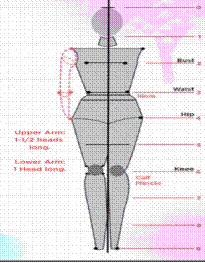
APLICATIONS
The stages of drawing the human sketch are:
1. We choose
a value for the height of the head and draw it vertically 9 times. The sketch
rendered with 9 times the height of the head is more elongated.
2. We draw
the axis of vertical symmetry, to be able to render the proportions of the body
horizontally/widthwise. The height of the neck is 1/2 of the height of the
head.
3. We draw
the shoulders, which have a width of 1÷1.5 the height of the head
4. We draw
the waist line, its width representing 3/4 of the height of the head.
5. We draw
the sketch/slit line and the knees. The width of the hips is equal to the width
of the shoulders. Draw the hands, their length, without the palm, positioning
themselves up to the level of the hip line. Palm length is the distance between
the hip line and the 5th line.
6. We draw
the calves of the legs, using curved lines.
7. We
finalize the drawing of the hands.
8. We draw
the sole of the foot, their height being 3/4 of the height of the head, between
lines 8 and
9. The final outline of the sketch is drawn.